Calm

(photo by Faye Cornish on Unsplash)

Today was a stressful day for me for a number of reasons. My stock trades did not go my way. I found a discrepancy on a tax form. There was a temporary, slow internet connection. It took a long time to get my printer to work properly. And it has been very noisy outside all day. Yet, here I am still standing at the end of the day, calmer now, after some uncalm moments earlier.

I admire individuals who can stay calm under pressure. Some individuals seem to be born with the calm under pressure gene, able to excel during chaotic moments. This is something I strive for, as I was not born with this gene.

Even those who are viewed as having a calm exterior still need to practice to become consistently good at handling pressure. With practice comes results, and ultimately confidence. So regardless of our personality, we can still improve in the area of remaining calm, even when challenges strike.

For me personally, I believe that my nervous system is more tightly wound up than others; meaning that my five (or six?) senses are more sensitive to the environment. My hearing is more sensitive to noise, for example. There is a small portion of the population that may have this type of nervous system. From a civilization view, it is important for some individuals to be on guard; to be on the lookout to protect others. Picture a group of Canadian geese in a field eating grass. There is always one goose not eating, with his head and neck at attention looking out for predators and people. Don’t get too close, or the goose will chase you and try and bite. So be careful, lol.

With a nervous system on heightened alert, it can certainly be a challenge to remain calm under most circumstances. Positive results can occur with practice, and with a determination to add healthy practices to your daily life. This will help lessen the nervous system attentiveness.

Here are a few practices that will benefit the nervous system, and thus, allow for being a little bit calmer.

DEEP BREATHING EXERCISES: These can be done anywhere. And no one will even notice that you’re doing them. Deep breathing can: calm down anxiety, increases energy level, and bring on better sleep.

One of Dr. Andrew Weil’s recommended deep breathing practices is called the 4-7-8 (or Relaxing Breathe) exercise:

  1. Exhale completely through your mouth making a whoosh sound.
  2. Close your mouth & inhale quietly through your nose to a mental count of 4.
  3. Hold your breathe for a count of 7.
  4. Exhale completely through your mouth, making a whoosh sound to 8.
  5. This is one breath. Now inhale again and repeat the cycle three more times for a total of four breaths.

MINDFULNESS: “By giving your full attention to this moment, an intelligence far greater than the egoic mind enters your life.”                              – Eckhart Tolle

Mindfulness can be practiced informally and formally.

Informally: Find mindful moments in everyday tasks. Pick a task, such as washing dishes, and focus your complete attention on the task as though it was the first time you were doing it. Use your five senses to truly be in the moment.

Formally: Brace yourself. I’m going to use the ‘M’ word… Meditation. Build your meditation muscles slowly and in very small time increments. Pick one time each day, preferably first thing in the morning before your mind gets on the thinking bandwagon. Set a timeframe, such as ten seconds, for example, to sit or lie down. Start by focusing your attention on your breathing, perhaps at your nostrils. Thoughts will naturally pop into your mind at random times. When they do, acknowledge the thought, and then bring your attention back to your breathing. In upcoming days or weeks, based on your comfort level, slowly and incrementally increase the ten second timeframe.

DOWN TIME: Research has found that taking breaks can improve your mood, boost your performance, and increase your ability to concentrate and pay attention. Give your mind a chance to pause and refresh, to keep it working efficiently.

“To be calm is the highest achievement of the self.” – Zen proverb

What is one small step that you can do to be a little calmer, now?


Healthcare for You

(photo by National Cancer Institute on Unsplash)

As a patient, I have had experiences with both Western (Allopathic) and Eastern  (CAM-Complimentary and Alternative) Medicine. Both practices provide necessary care, yet each approach is different.

Western medicine focuses on diagnosing and treating a disease or illness based on a patient’s symptoms. According to the National Cancer Institute (NCI), Western medicine can be defined as, “A system in which medical doctors and other healthcare professionals treat symptoms and diseases using drugs, radiation, or surgery.”

“The basic philosophy of Eastern medicine practitioners is to treat the whole person, encouraging a healthy body to prevent illness and speed recovery.” Eastern medicine considers both the patient’s symptoms and an individualized diagnosis of a patient’s ‘Qi’ (or chi). Eastern medicine views the mind and body as one interconnected unit. When we do not feel well (physically, mentally, or emotionally), this is a sign that our body is out of balance in some way. Processes focus on bringing the body back to balance.

Here are some of my own personal experiences with Allopathic medicine.

As a child, I had an accident that required stitches. I was rushed to the hospital, and was quickly taken as an emergency. Stitched up, fixed up, done.

As a teenager, I had too many teeth in my mouth. If I did nothing, I may have had challenges as an adult. An oral surgeon pulled several teeth out (not all at once, haha). I’ll never forget the smell of peppermint gas that knocked me out causing some crazy dreams during the surgeries.

And, I had two experiences where two different doctors gave me prescription medicine, for sleep and stomach issues. While these medicines are helpful for others, they did not work for me.

Lastly, I contracted Lyme Disease from a tick bite. At the emergency room, I was given antibiotics immediately to begin the process.

The above examples show that my Allopathic experiences were either emergency situations that needed immediate care and attention, surgeries that were deemed necessary to help me later in life, and prescription drugs.

Now here are my Eastern medicine examples:

For Lyme Disease (LD), after seeing my PCP, I met with a Naturopathic Doctor (ND). An ND goes to medical school just like an MD does. However, instead of learning about prescription drugs and surgery, the ND studies nutrition, homeopathic remedies, acupuncture, and counseling.  To combat the LD, I was given homeopathic remedies, supplements, and acupuncture treatments, along with a recommendation to use food as medicine, sticking to an organic, whole-foods diet. The goal was to boost my immune system. A test at the beginning of treatment confirmed that I had one strand (out of four) of LD. At the end of the treatment, test results showed no LD strands present.

I saw an ND for my stomach issues as well. The same protocols were given (acupuncture, diet change, supplements) to build up the immune system. A month or two after this process, my chronic stomach pain was gone, and my energy was up.

One area of my health that I can’t seem to figure out, even with eastern medicine, is sleep. My long-standing sleep issues are still prevalent. However, a few of the times that I had acupuncture specifically for sleep issues, I either fell asleep during the acupuncture session, or fell asleep easily that night. So that’s progress.

Some States allow naturopathic doctors to be primary care physicians. Someday, I’d like to make this switch. However, my State is one that does not yet allow this. But more States are coming on board each year.

Ultimately, a combination of Western and Eastern medicine is best. Find the best combination for you. Many individuals try alternative medicine to alleviate chronic ailments when Western protocols are not successful. If you are open to Eastern medicine, give it a try. Explore an alternative medicine treatment  in conjunction with your allopathic methods, and get the best of both worlds.

What is one small step you can do for your own health now?


Plan Ahead

(photo by Estee Janssens on Unsplash)

When I worked in the corporate world as an accountant, there would always be deadlines, especially at the end of the month. I would be swamped with tasks to get done. Somehow I usually met these deadlines, with a lot of stressful moments. Sometimes it would be completed right at the deadline. Occasionally, I would be late and be granted a little extra time. Eventually I realized that I could automate some of my tasks in the spreadsheet software. So during the slower part of the month, I began to create new spreadsheets with formulas, pivot tables, and other methods. This way, when the end of month financials came in, I would be further along in the process. Each month, I would add more automation. Eventually, some of my task time was cut down by forty to fifty percent. The less time I needed to create these reports allowed for more time to analyze the numbers, which was the important part.

I recently had an appointment at the motor vehicle agency. I waited until the week of the appointment to search for and gather all the documents needed for my visit. What would have happened if I could not find some of the documents? I may have run out of time. Yet, I scheduled the appointment a month in advance. I could have set aside time on my calendar three weeks ago to search for the papers, put them in a folder, and placed them somewhere safe.

Moving forward to today’s project at home, I am working on my individual tax return, which is due a week from today. Here I am again, up against a deadline, feeling the similar stressors from the corporate job. It sure would have been nice if this task was completed well in advance. I can hear the voice in my head say, “Next year will be different.” I did not procrastinate this year. Actually, I purchased the tax software and entered a majority of numbers into the return a while back. But then I put it on hold to take care of other pressing projects. That was my mistake. Ideally, I would have continued to move forward with the next tax return steps, even if it was one item each week. That would have kept the momentum going. Instead, when I picked up the work again recently, I had to re-acclimate myself to some of the transactions, which was like doing double the work.

We all have our daily tasks that need to be done. And we may spend all our time each day focused on the things we have to do today. However, what if we took time aside each day, even just a few minutes, to work on a task that does not contain the burden of an immediate deadline.

When we first become aware of a task or event, we can take out a few minutes to identify and write down the action steps required. Perhaps use visualization techniques, as one example, to envision the completed task, or to see ourselves at the future event; to help identify these action steps. Then, utilize a calendar to block off time for ourselves to do the work, bit-by-bit, over time. Stress less. Complete more.

What is one small step you can do to begin a future project, now?

Sleep

Last night, I stayed up way too late. Finally getting to bed at 1am, I was not a happy camper waking up this morning, tired and cranky.

I completed yesterday’s blog and related tasks after 10pm. So I was staring at a computer screen for several hours up until my bedtime. Upon completion, I had a burst of energy, excited to have completed another day of blogging. Ideally, I would have wound down quietly and gone to bed. But instead, I decided that I needed to wind up by way of watching some YouTube videos. After a few quick tries of lying down to sleep, I got antsy, got up, had a midnight snack, and turned on my cell phone.

Of course, a racing mind, computer screens, and sleep do not mix. Yet, there can be many reasons, some obvious, some not, why one has sleep challenges. I have had sleep struggles for years. I was a deep sleeper in junior high school. But in high school I became a light sleeper. Every little noise wakes me up, or keeps me up.

Even though it is unclear many times why I am unable to sleep, or stay asleep, there are healthy habits that I can implement that provide a greater likelihood of getting a restful sleep.

Here are some that work for me. What are some of yours?

Regular sleep and wake up times. This helps the body to get into a natural rhythm.

Allow three hours or more of no eating prior to bedtime.  The digestion process takes energy.

A whole food plant-based diet and limiting/avoiding processed foods.

Supplements. Everyone has specific and unique nutrition needs that may not be achieved solely through the food that we eat.

Stop (left-brain) thinking at least an hour before bedtime. Do (right-brain) creativity tasks to wind down and to get out of the thinking mind. Some examples may include listening to instrumental music, deep breathing exercises, meditation, drawing, journaling, light stretching. I also enjoy doing these things first thing in the morning, as a way to connect with my unconscious mind, which was active while sleeping.

Take breaks during the day, and get outside.

Exercise. Optimally, this would include a mix of cardio, strength training, and stretching. Focusing attention on the breath while exercising helps too. Sometimes I forget to breathe when holding a yoga pose, for example.

If I’m having trouble staying asleep at night, I see if there is a pattern regarding the time that I wake up. For a long time, I would always wake up around 1am. Traditional Chinese Medicine utilizes a Chinese Body Clock. One concept of this clock is that each organ of the body has an optimal two hour window each day to perform their specific tasks. For me, I wake up at 1am. 1am-3am on the Chinese Body Clock represents the Liver. The emotion that the Liver represents is Anger. Thus, by resolving my anger issues, sleeping through the night may be achieved.

How are your sleep habits?

What is one small step you can take towards a better night’s sleep?

Juicing

Have you ever juiced vegetables? If so, what was your experience like?

I dusted off my juicer last week, As of today, I have juiced once a day for five straight days. My juicer is the kind that separates the juice from the pulp. So, I’m not getting the benefits of eating the fiber component of the vegetables or fruit. So why would I even think to do this?

I purchased my juicer many years ago. My first experience was at a time when I was not feeling well. Two of my symptoms were slow digestion and brain fog. At the time, I was doing research on various holistic health topics, and came across the topic of juicing. I recall reading that juicing can allow for quick nutrition absorption into the body, and thus, allow the body to work less to digest it. Because I had slow digestion, I wanted to try it.

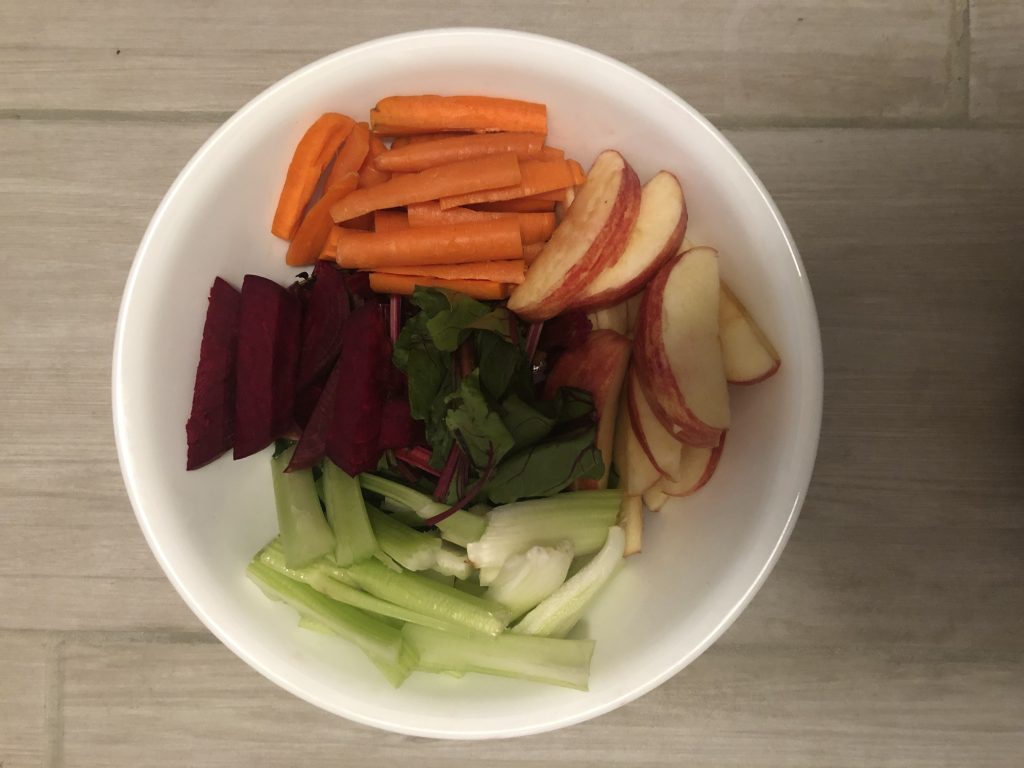
And try it I did. I remember purchasing some organic vegetables including beets, carrots, celery, and apples. I had a juice for breakfast and dinner for five days in a row. By the fourth day, my brain fog lifted. And for a couple of days thereafter, I felt like Albert Einstein. It was an amazing feeling. It took extra steps beyond juicing to fix my slow digestion, but I was extremely happy with the results.

The five days of juicing that I just did this week did not have the same huge impact that it did the first time. If I had to guess, that’s probably because my diet back then was not as good as it is now. So the first juicing experience was probably a big jolt to my system.

I do not recommend replacing whole vegetables with juiced veggies. Rather, use juice as a supplement to eating veggies. This way you still get the fiber intake from whole veggies, along with an extra kick of nutrients with the drink.

However, with juicing, it is essential to drink immediately upon juicing. The longer the juice sits out, the less nutrients that it contains. That is why purchasing vegetable or fruit juice at a supermarket will not provide the same nutritional value. Because the bottled juice was made a long time ago, and probably contains extra unhealthy ingredients, this makes them a poor choice.

Additionally, whether you eat or drink veggies, it is most beneficial to prepare a variety of veggies based on the colors of the rainbow. The more colorful your plate or glass, the more nutrient riches your body will receive.

Be careful with the fruit that you select to juice or eat. Many fruits have high sugar content. Even though it is natural sugar, it can still produce a blood sugar spike. And for those with digestive (and various other) issues, it can exacerbate symptoms. Refer to a glycemic index chart (found on the internet) for a list of various foods and their corresponding glycemic index scores. The standard Glycemic Index ranges from 0-100. The lower the food is on the GI, the lower the effect on your blood sugar.

There are gadgets on the market that will juice/blend the entire vegetable or fruit, keeping the fiber intact. I have not tried this type of juicer yet, so I cannot offer an opinion on it.

And if your juicer separates the pulp, the fiber does not have to be thrown out. It can be used to make veggie broth, to blend into a smoothie, to add to soup, and even to use in the backyard as compost.

Juicing is all about experimenting. Some may fall a little flat. It’s a great feeling when it tastes just right.